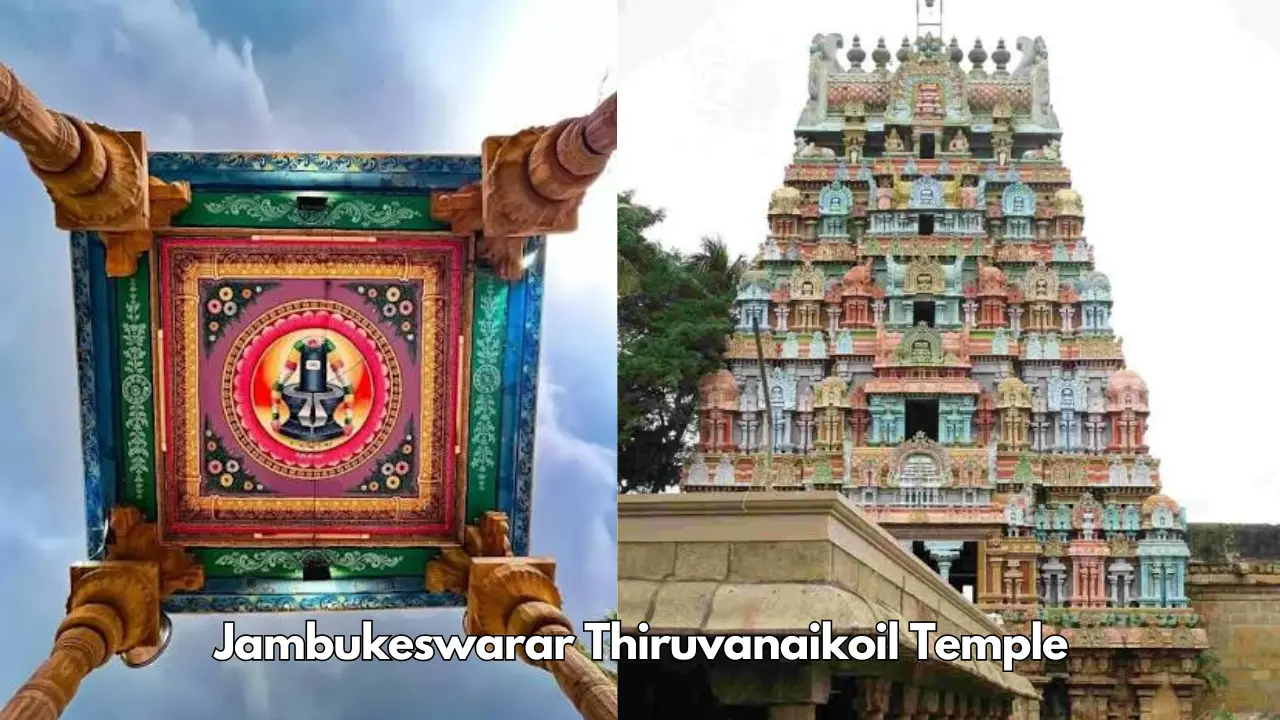
The Jambukeswarar Temple in Thiruvanaikaval is one of the most unique and spiritually significant famous ancient temples in Trichy. Built approximately 1,800 years ago by the Early Chola king Kochengat Cholan.
This temple is one of the five Pancha Bhoota Sthalams, representing the element of Water (Neer). Located just 11 km from Trichy Junction on the Srirangam island.
The temple is a must-visit for anyone exploring the Rockfort and Srirangam tour circuit.
The Legend of Jambukeswarar: Elephant, Spider, and Red-Eyed King
The temple’s origin story is unique among Shiva temples. Two of Shiva’s ganas, Pushpadanta and Malyavan, were cursed to be born on earth as an elephant and a spider.
Both worshipped a Shiva Lingam under a Jambu (rose apple) tree in a forest. The elephant performed ablution with water from the Kaveri. While the spider built webs to protect the Lingam from falling leaves and sun. The elephant mistook the webs for dirt and destroyed them, leading to a fatal clash .
The spider.. born in the next life as King Kochengat Cholan (“red-eyed king”), remembered his enmity with the elephant. He built 70 temples, including Jambukeswarar, as the first. With a sanctum entrance only 4 feet high and 2.5 feet wide – so small that no elephant can enter .
Key Data: 1,800-year-old temple; 70 temples built by King; 4 ft high x 2.5 ft wide sanctum entrance; 9 Theerthams.
The Water Principle (Appu Sthalam)
This temple represents the Water element (Jala Tatvam) among the Pancha Bhoota Sthalams (the other four being Earth in Kanchipuram, Fire in Tiruvannamalai, Air in Kalahasti, and Space in Chidambaram).
The central feature is the Appu Lingam (Water Lingam). Which sits in a small room below ground level. A natural underground stream constantly keeps the Lingam partially submerged in water.
Despite attempts to pump the water out, it inexplicably refills. This fascinating phenomenon makes unique compared to the nearby Samayapuram temple visit which focuses on Goddess Mariamman.
Key Data: One of 5 Pancha Bhoota Sthalams; Water element; Underground stream; Lingam always submerged.
Noon Pooja: Goddess Parvati’s Daily Worship
A unique daily ritual sets this temple apart. According to legend, Parvati mocked Shiva’s penance, leading him to send her to earth as Akilandeswari to perform penance. To this day.. Goddess Akilandeswari is believed to worship the Lingam daily at noon.
A male priest (Archakar) dresses in a saree as Goddess Parvati and performs the midday pooja (12:00 PM – 12:30 PM) , a symbolic reenactment of this legend. Marriages are not conducted here because Shiva and Parvati are seen as Guru (teacher) and Shishya (student), not as a couple.
Key Data: Noon pooja daily at 12:00 PM; Priest dresses as Goddess; No marriages conducted here.
Adi Shankara’s Visit: The Tatanka (Earring) Installation
Adi Shankara is believed to have visited this shrine and performed the Tatanka (earring) Pratishta for Goddess Akilandeswari to ensure she remains in a peaceful (Sowmya) form.
The goddess Akilandeswari.. like Meenakshi of Madurai and Kamakshi of Kanchipuram is worshipped as a powerful form of Parvati. A Sri Sankara Matham is located right beside the temple on North Mada Street. Built to commemorate his visit.
Key Data: Adi Shankara visited; Tatanka earring installation; Sankara Matham beside temple.
Temple Timings & Darshan Information
| Activity | Timings |
|---|---|
| Temple Open | 6:00 AM – 1:00 PM, 3:00 PM – 8:00 PM |
| Special Entry Ticket | ₹25 (for faster queue; maximum 10 people allowed inside at once due to narrow space). |
| Noon Pooja | 12:00 PM – 12:30 PM |
| General Darshan | Free entry; accessible to all |
Travel Tip: The main shrine is small and can feel cramped. If you are claustrophobic, be cautious. Visit early morning to avoid crowds.
Temple Architecture
The temple complex spans 18 acres with five concentric walls, seven gopurams, and a thousand-pillar hall featuring approximately 470 columns on one side and a tank fed by a perpetual spring on the other.
It is considered the fifth largest temple in Tamil Nadu by area.
| Aspect | Details |
|---|---|
| Area | 18 acres |
| Walls / Enclosures | 5 concentric walls |
| Gopurams | 7 |
| Pillared Hall | Thousand-pillar hall (~470 columns on one side) |
| Architecture | Dravidian; exquisite stone carvings; intricate sculptures. |
Key Data: 18 acres; 5 walls; 7 gopurams; 5th largest temple in TN.
Festivals & Special Days
| Festival | Time | Significance |
|---|---|---|
| Panguni Brahmmotsavam | March-April | Major annual temple festival |
| Aadi Pooram | July-August | Special celebrations for Goddess |
| Navarathri | September-October | Goddess dressed differently on all 9 days; musical/dance programs. |
| Aadi & Thai Fridays | July-Aug, Jan-Feb | Thousands of devotees visit |
Key Data: Navarathri = 9 days of special alankaram; Aadi/Thai Fridays = 1,000+ visitors.
Visitor Essentials
What to Expect
- Unique Experience: Viewing the water-emanating Lingam in the underground sanctum is unforgettable
- Architecture: Mind-blowing stone carvings and towering gopurams.
- Crowds: Special days (Fridays, festivals) see heavy rush.
- Facilities: Basic amenities are limited (toilets reportedly lacking). Carry water and snacks.
Travel Tips
- Best Time: October to March for pleasant weather.
- Dress Code: Modest attire recommended (traditional wear preferred).
- Visit Duration: Allocate 2-3 hours to explore the entire complex.
- Booking: Special entry ticket costs ₹25 and allows faster entry in limited batches.
- Getting There: Located on Srirangam island.. easily accessible from Trichy city (approx. 11 km from Trichy Junction).
Frequently Asked Questions
1. What is Jambukeswarar Temple famous for?
It is one of the five Pancha Bhoota temples representing the Water element. A natural underground stream keeps the Shiva Lingam constantly submerged.
2. Why is the sanctum entrance so small?
King Kochengat Cholan, who built the temple.. was a spider in his previous life and had an enmity with an elephant. He built the entrance so small that no elephant can enter.
3. What is the special noon pooja at Jambukeswarar?
At exactly 12:00 PM.. a priest dresses as Goddess Parvati and performs the pooja, symbolizing her daily worship of Shiva.
4. How old is Jambukeswarar Temple?
The temple is approximately 1,800 years old. Built by the Early Chola king Kochengat Cholan.
5. What are the temple timings?
The temple is open from 6:00 AM – 1:00 PM and 3:00 PM – 8:00 PM daily.
6. Is there a special darshan ticket?
Yes, special entry costs ₹25 and allows faster darshan. Only 10 people are allowed inside the main shrine at a time due to space constraints.
Conclusion
Jambukeswarar Thiruvanaikoil Temple is a magnificent blend of legend, architecture, and spiritual symbolism. From its 1,800-year-old history and unique “water lingam” to the intriguing noon pooja and elephant-proof sanctum.
Every aspect tells a story. For those planning a Rockfort and Srirangam tour. This temple adds a unique dimension to the spiritual journey.
Combine it with a Samayapuram temple visit for a complete spiritual circuit. Explore more famous ancient temples in Trichy to deepen your understanding of Tamil Nadu’s rich heritage.